
Cornell University Center for Advanced Computing
High performance computing and research centre at Cornell University
The Cornell University Center for Advanced Computing (CAC) is a high performance computing facility located at Cornell University in Ithaca. Established in 1985 as part of the National Science Foundation Supercomputer Centers Program, it provides computational resources for scientific research and industry partners.
- Established in 1985 as an NSF Supercomputer Center
- Housed in Frank H. T. Rhodes Hall in Ithaca
- Played key role in early NSFNet internet development
- Partners include Boeing, Intel, Microsoft and Pfizer
- Deploys cloud services like Red Cloud and Aristotle
What it is
The Cornell University Center for Advanced Computing (CAC) operates within Frank H. T. Rhodes Hall on the university campus in Ithaca. It serves as a hub for high performance computing, offering resources to faculty, students, and external industry partners. Originally known as the Cornell Theory Center, it was one of five initial sites funded by the National Science Foundation to advance supercomputing capabilities in the United States. The centre focuses on parallel computing, cloud infrastructure, and complex scientific modelling.
How it came about
Established in 1985 under Nobel Laureate Kenneth G. Wilson, the centre began as the Cornell Theory Center. It played a pivotal role in the early development of the internet through its involvement with NSFNet, a network that connected to ARPANET and grew from 56-kbit/s to 45 Mbit/s by 1991. In 1995, its host building was named after Frank H. T. Rhodes. The centre has since evolved from pure supercomputing to include cloud services like Red Cloud and Aristotle, maintaining its status as a key partner in national research initiatives such as XSEDE.
The building and the halls
The facility is housed in Frank H. T. Rhodes Hall, an eight-story structure situated on a narrow, triangular plot between Hoy Road and Cascadilla Gorge. During its construction phase in 1989, designers used ray tracing simulations with soft shadowing techniques to visualise the stair tower and other architectural elements before completion. This approach allowed for detailed planning of the building's aesthetic and functional spaces prior to finalising the physical structure.
Power and cooling
Specific details regarding power capacity, energy sources, or cooling systems are not provided in the available records. The centre focuses on computational efficiency and scalable parallel resources rather than publicising its physical infrastructure metrics. Its operations support intensive computing tasks, including large-scale simulations and data analysis, which typically require significant electrical input and thermal management, though exact figures remain unspecified.
What runs inside
CAC supports a wide range of users, including Cornell academics, national researchers, and corporate partners such as Boeing, Intel, and Pfizer. It provides high performance computing services, consulting, and training for projects like the Frontera supercomputer and multi-messenger astrophysics research. The centre also develops cloud images and containerised applications, facilitating efficient software deployment for scientific and engineering problems across various disciplines.
The place
Located in Ithaca, New York, the centre benefits from its position within a major research university. The site was chosen to integrate academic research with advanced computational tools. Its presence contributes to the local academic ecosystem, providing students and faculty with access to cutting-edge technology. The building's unique location near Cascadilla Gorge adds distinct geographical character to the campus infrastructure.
Environment and impact
The centre has contributed significantly to the development of the internet through its early work on NSFNet. It continues to influence scientific research by enabling complex computations, such as hepatitis C modelling, at speeds far exceeding traditional methods. By partnering with industry leaders and supporting open science projects, CAC helps bridge the gap between academic theory and practical application, fostering innovation in both public and private sectors.
Network and links
In the late 1980s and early 1990s, the centre was instrumental in the creation of NSFNet, a backbone network that connected regional networks to ARPANET. This infrastructure laid the groundwork for the modern internet, facilitating exponential growth in data traffic and connecting academic institutions across the country. Today, it remains connected to national research networks, supporting data-intensive projects and collaborative scientific efforts.
Questions people ask about Cornell University Center for Advanced Computing
What is the Cornell University Center for Advanced Computing?
It is a high performance computing facility at Cornell University, originally established in 1985 as the Cornell Theory Center. It provides supercomputing resources and cloud services for research and industry partners.
Where is the center located?
The center is housed in Frank H. T. Rhodes Hall on the Cornell University campus in Ithaca, New York. The building sits on a triangular site near Cascadilla Gorge.
Who uses the facilities at CAC?
Users include Cornell faculty and students, national researchers, and corporate partners such as Boeing, Dell, Intel, Microsoft, and Pfizer. It supports both academic and industrial computational needs.
Good reading and sources
The facts on this page come from the Wikipedia article "Cornell University Center for Advanced Computing", written by its contributors and used under the CC BY-SA 4.0 licence, and from its Wikidata record (CC0). EveryDatacenter rewrote the text in its own words, with AI assistance, and compares every page with the article to make sure no passage is copied. It may be reused under the same CC BY-SA 4.0 licence with a link back.
It may contain mistakes, and figures change over time. Nothing here is investment or buying advice. If something is wrong, tell us. Last refreshed 2026-11-14.
Like Cornell University Center for Advanced Computing
All supercomputer centres 🇺🇸 United StatesOhio Supercomputer Center
Statewide high performance computing resource for research and education in Ohio.Supercomputer centre · Grid power · 1987
 🇫🇷 FranceCINES
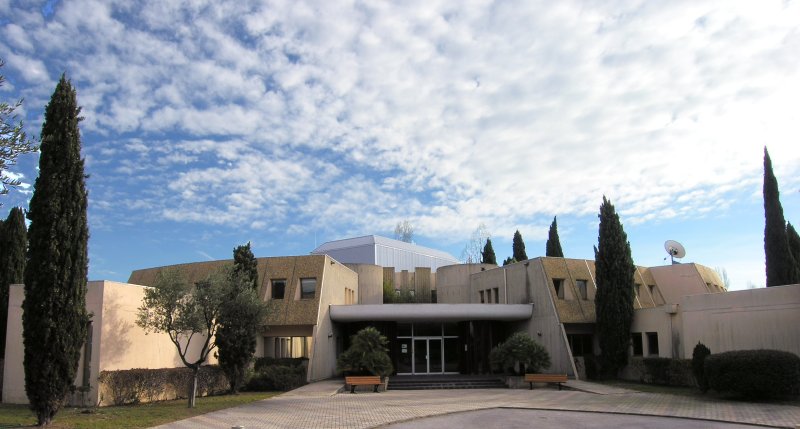
French national supercomputing and digital archiving centre in Montpellier.Supercomputer centre · Grid power · 1980
 🇺🇸 United StatesNational Energy Research Scientific Computing Center
A US Department of Energy supercomputer facility for scientific research.Supercomputer centre · Grid power · 1974
🇿🇦 South AfricaCentre for High Performance Computing
South Africa's national supercomputing facility for research and industry.Supercomputer centre · Grid power · 2007
More from Cornell University
All of them 🇺🇸 United StatesNational Center for Supercomputing Applications
High-performance computing and research centre at the University of Illinois.Supercomputer centre · 1986
🇺🇸 United StatesNational Supercomputing Center for Energy and the Environment
A supercomputer centre at UNLV in Las Vegas focused on energy and environment research.Supercomputer centre · Grid power · 1989
🇺🇸 United StatesMAE-East
First non-governmental Internet exchange point, running from 1992 to 2009.Interconnection · 1992