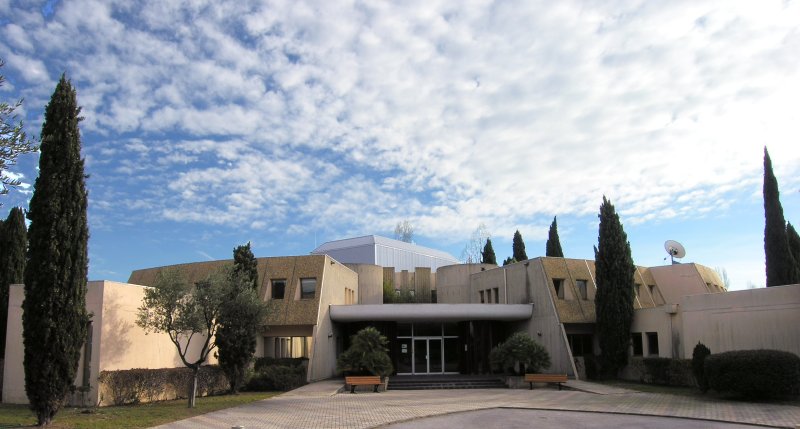
CINES
French national supercomputing and digital archiving centre in Montpellier.
CINES is a public institution in Montpellier that provides high-performance computing and long-term digital archiving for French research. Established in 1999 from an earlier university centre, it operates major supercomputers and hosts national equipment under the Ministry of Higher Education.
- Operates the Occident supercomputer with 3.5 petaflops peak power.
- Archives French doctoral theses and scientific publications.
- Transformed from CNUSC to CINES by decree in 1999.
- Hosts national computer equipment for institutions lacking space.
What it is
The National Computer Center for Higher Education, known as CINES, is a public body based in Montpellier. It operates under the supervision of the Ministry of Higher Education and Research. The centre focuses on three main tasks: providing supercomputing power, preserving digital documents long-term, and hosting national computer hardware. It serves the wider French scientific community by offering resources that individual universities cannot maintain alone.
How it came about
The organisation began as the National University Center for Computation in 1981. This earlier entity hosted scientific applications and librarianship tools. In April 1999, a government decree transformed it into CINES, expanding its mission and legal status. A further decree in March 2014 added the responsibility for hosting national computer equipment. Throughout these changes, the staff remained small, with around forty engineers and technicians supporting operations.
The building and the halls
The facility is designed to accommodate computing infrastructure in industrial quantities. It provides rack space and the necessary technical environment for large-scale machines. This includes power distribution and air conditioning systems that run continuously. The centre supports organisations that lack the physical space or maintenance capabilities to host such heavy equipment on their own premises.
Power and cooling
CINES manages several high-performance computing systems. The Occident machine, also called BullX, delivers 3.5 petaflops of peak power using thousands of Intel processor cores. It connects via high-speed InfiniBand networks and stores five petabytes of data. Earlier systems included the Jade supercomputer, which ranked highly in global lists in 2010. The centre regularly updates its hardware to keep pace with technological progress.
What runs inside
Researchers use the centre for complex simulations, measurements, and calculations. It also acts as a national archive for digital heritage, including doctoral theses, scientific articles, and administrative university records. The hosting mission allows other public bodies to place their server racks at CINES. This shared model helps institutions avoid the cost and difficulty of maintaining their own industrial-grade data halls.
The place
Located in Montpellier, the centre has been a hub for academic computing since the early 1980s. Its urban setting provides access to skilled engineers and researchers in the region. As a national facility, it draws users from across France rather than just the local area. The site was chosen to centralise expensive computing resources for the public sector.
Environment and impact
CINES supports the preservation of France’s scientific output through its archiving mandate. By maintaining strict standards for data formats and risk management, it ensures long-term access to digital records. The centre employs a modest team of specialists who manage both the hardware and the archival processes. Its work enables research that would otherwise be impossible due to computational limits.
Network and links
The centre collaborates with GENCI, the national agency for intensive computing equipment. This partnership helps coordinate resources across France. High-speed internal networks like InfiniBand connect the computing nodes within the supercomputers. The facility serves as a key node for distributing processing power to universities and research labs nationwide.

Questions people ask about CINES
What is the main purpose of CINES?
CINES provides high-performance computing power, long-term digital archiving, and hardware hosting for the French public research community. It helps universities and labs access supercomputers and preserve digital data without building their own facilities.
Which supercomputers does CINES operate?
It currently operates the Occident machine, also known as BullX, which has a peak power of 3.5 petaflops. Past systems include the Jade supercomputer, which was ranked among the top globally in 2010, and various IBM and SGI clusters.
Who owns and runs CINES?
CINES is a public institution supervised by the French Ministry of Higher Education and Research. It was created by government decree in 1999 and works in collaboration with the national computing agency GENCI.
Good reading and sources
- National Computer Center for Higher Education (France) on WikipediaEncyclopedia
- More photos on Wikimedia CommonsPhotos
- Wikidata recordOpen data
The facts on this page come from the Wikipedia article "National Computer Center for Higher Education (France)", written by its contributors and used under the CC BY-SA 4.0 licence, and from its Wikidata record (CC0). EveryDatacenter rewrote the text in its own words, with AI assistance, and compares every page with the article to make sure no passage is copied. It may be reused under the same CC BY-SA 4.0 licence with a link back.
It may contain mistakes, and figures change over time. Nothing here is investment or buying advice. If something is wrong, tell us. Last refreshed 2026-11-14.
Like CINES
All supercomputer centres 🇺🇸 United StatesOhio Supercomputer Center
Statewide high performance computing resource for research and education in Ohio.Supercomputer centre · Grid power · 1987
🇺🇸 United StatesMultiprogram Research Facility
Classified NSA supercomputer centre at Oak Ridge National LaboratorySupercomputer centre · Grid power · 2006
🇿🇦 South AfricaCentre for High Performance Computing
South Africa's national supercomputing facility for research and industry.Supercomputer centre · Grid power · 2007
 🇨🇳 ChinaNational Supercomputing Center in Guangzhou
Chinese national supercomputing centre in Guangzhou housing Tianhe-3.Supercomputer centre · Grid power · 2014