NASA Advanced Supercomputing Division
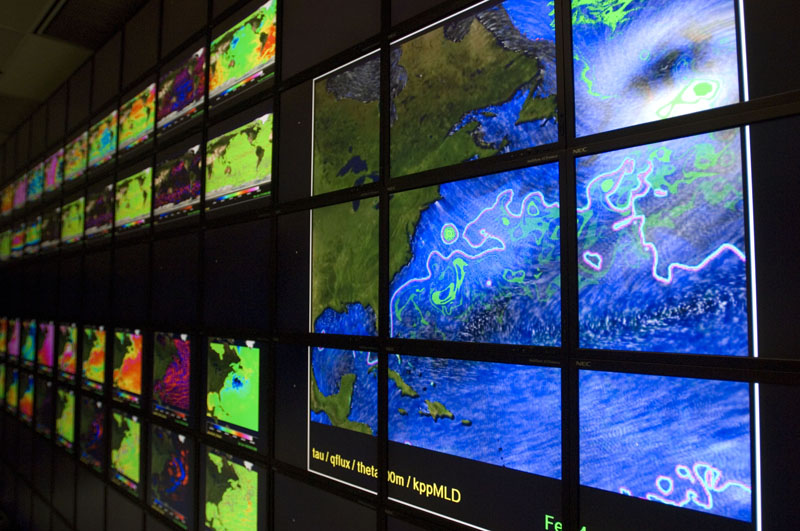
NASA's supercomputing centre at Ames Research Center in Mountain View, California.
The NASA Advanced Supercomputing Division runs the agency's main modelling and simulation centre at Ames Research Center, Moffett Field, in Mountain View, California. Founded in 1982, it supports work on aerodynamics, space flight, weather and ocean studies, and vehicle design using large supercomputers, storage systems and visualisation tools.
- Founded in 1982; the dedicated building was dedicated on 9 March 1987.
- Holds Pleiades, Aitken, Electra and the terascale Endeavour supercomputers.
- Archival tape capacity reached 1 exabyte by March 2019.
- hyperwall-2 uses 128 LCD screens and reached 512 teraflops after a 2020 upgrade.
- Co-developed the RAID disk storage concept with DARPA and UC Berkeley.
What it is
The NASA Advanced Supercomputing Division is the agency's central facility for high-end computing, based at Ames Research Center on Moffett Field in Mountain View, California. It sits in Silicon Valley and has served NASA for close to four decades. The centre supports simulation and modelling work covering aerodynamics, space exploration, weather patterns, ocean currents, and the design of spacecraft and aircraft. Machines on site include the petascale systems Pleiades, Aitken and Electra, plus the terascale Endeavour. Hardware comes from SGI and HPE designs built around Intel processors. Alongside the computers, the building holds disk and tape storage holding more than an exabyte, a large visualisation display called the hyperwall, and one of the world's biggest InfiniBand fabrics. The division sits within NASA's Exploration Technology Directorate and runs the High-End Computing Capability project.
How it came about
During the mid-1970s, engineers at Ames began moving aerospace research away from costly wind tunnel tests toward simulation, using computational fluid dynamics on machines stronger than anything then sold commercially. That effort became the Numerical Aerodynamic Simulator project, and its first computer arrived at the Central Computing Facility in 1984. Construction of a dedicated building began with a groundbreaking on 14 March 1985, aimed at putting fluid dynamics experts, computer scientists, visualisation staff, and network and storage engineers together in one place. The group became a full NASA division in 1986. Staff and equipment, including a Cray-2 called Navier, moved into the new building in 1987, and it was formally dedicated on 9 March that year. The name changed to Numerical Aerospace Simulation Division in 1995, then to its present title in 2001.
The building and the halls
The purpose-built centre opened in 1987 so that specialists in fluid dynamics, computing, visualisation, networking and storage could work side by side. Its main building contains the supercomputers together with disk and archival tape systems holding over an exabyte, the hyperwall display, and a very large InfiniBand network fabric. Storage hardware includes an SGI parallel DMF cluster with four 32-processor front-end systems, each with 192 GB of memory and 7.6 petabytes of disk cache. Data on disk is moved regularly to tape to leave room for other projects. Spectra Logic T950 robotic tape libraries were added in 2009, and by March 2019 the tape estate reached 1,048 petabytes with 35% compression.
Power and cooling
The division's computing estate runs on SGI and HPE systems built around Intel processors. Peak capability is measured in floating point operations per second. The hyperwall display has been upgraded twice: in 2014 it gained 256 Intel Xeon "Ivy Bridge" chips and 128 NVIDIA GeForce 780 Ti graphics units, lifting peak output from 9 to 57 teraflops with close to 400 gigabytes of graphics memory. A 2020 refresh fitted 256 Intel Xeon Platinum 8268 processors and 128 NVIDIA Quadro RTX 6000 graphics cards, taking the total to 512 teraflops and 3.1 terabytes of graphics memory. No power capacity or cooling method is stated for the site.
What runs inside
NASA teams use the centre for aerodynamics, space exploration, weather and ocean studies, and vehicle design. The National Hurricane Center received forecasts from a model run on the Columbia supercomputer in 2005 through a concurrent visualisation pipeline built by NAS staff. Software written here is often shared under the NASA Open Source Agreement. Notable tools include the NAS Parallel Benchmarks, the Portable Batch System, PLOT3D, FAST, INS2D and INS3D, Cart3D, OVERFLOW, Chimera Grid Tools and HiMAP. Several of these earned NASA Software of the Year awards, and the PLOT3D team received a major prize from the NASA Space Act Program.
The place
The centre sits at Ames Research Center on Moffett Field, in Mountain View at the heart of Silicon Valley. That location put it near the computing industry it drew on: NAS bought 25 SGI IRIS 1000 graphics terminals in 1984, beginning a long relationship with the local firm, and later worked with SGI and Colfax International on hardware. Being in Silicon Valley also placed the division close to the companies whose architecture and processors its systems use.
Environment and impact
Work at the centre helped shift aerospace design from wind tunnel testing toward simulation, which reduced reliance on costly and slow physical tests. Its storage research had wider effects: a RAID project run with DARPA and the University of California, Berkeley from 1987 to 1992 produced the distributed disk technology used today. Tools such as the Portable Batch System, released commercially in 1998, spread into industry. The division also built AEROnet, a wide area network linking supercomputers to remote users, and co-developed NASA's Metacenter for spreading work across distant machines.
Network and links
NAS helped pioneer networking in supercomputing. It built AEROnet, a high-speed wide area network connecting its machines to users elsewhere, and co-developed the NASA Metacenter, which moved production work between geographically separate resources. Staff also brought TCP/IP into supercomputing environments and linked supercomputers to workstations through a client/server model for shared computation and visualisation. Inside the building, one of the world's largest InfiniBand fabrics connects the computers, storage and the hyperwall-2 display, which reads straight from the Pleiades filesystem over that network.

Questions people ask about NASA Advanced Supercomputing Division
What does the NASA Advanced Supercomputing Division do?
It provides high-end computing for NASA missions, running simulations in aerodynamics, space exploration, weather and ocean studies, and aircraft and spacecraft design. The division operates the agency's High-End Computing Capability project from Ames Research Center in Mountain View, California.
Which computers are housed there?
The site holds the petascale Pleiades, Aitken and Electra systems, plus the terascale Endeavour machine. Hardware is based on SGI and HPE designs using Intel processors. Testbed systems have also been run there to try out new architectures, hardware and networking before wider use.
How much data can the facility store?
Disk and tape systems in the main building hold more than an exabyte in total. By March 2019 the Spectra Logic tape libraries reached 1,048 petabytes with 35% compression, and over 110 petabytes of unique data sat in the archive. Disk cache on the SGI cluster totals 7.6 petabytes.
What is the hyperwall?
It is a large visualisation display built at NAS. The first version, from 2002, used 49 linked LCD panels in a seven-by-seven array. hyperwall-2, from 2008, uses 128 screens in an 8x16 grid, 23 feet wide and 10 feet tall, and reached 512 teraflops after upgrades in 2014 and 2020.
What software has come out of the division?
Staff created the NAS Parallel Benchmarks, the Portable Batch System, PLOT3D, FAST, INS2D and INS3D, Cart3D, OVERFLOW, Chimera Grid Tools and HiMAP. Several won NASA Software of the Year awards. Much of the software is shared with users through the NASA Open Source Agreement.
Good reading and sources
- NASA Advanced Supercomputing Division on WikipediaEncyclopedia
- More photos on Wikimedia CommonsPhotos
- Wikidata recordOpen data
The facts on this page come from the Wikipedia article "NASA Advanced Supercomputing Division", written by its contributors and used under the CC BY-SA 4.0 licence, and from its Wikidata record (CC0). EveryDatacenter rewrote the text in its own words, with AI assistance, and compares every page with the article to make sure no passage is copied. It may be reused under the same CC BY-SA 4.0 licence with a link back.
It may contain mistakes, and figures change over time. Nothing here is investment or buying advice. If something is wrong, tell us. Last refreshed 2026-11-14.
Like NASA Advanced Supercomputing Division
All supercomputer centres 🇫🇷 FranceCINES
French national supercomputing and digital archiving centre in Montpellier.Supercomputer centre · Grid power · 1980
🇺🇸 United StatesOak Ridge Leadership Computing Facility
US Department of Energy supercomputing user facility at Oak Ridge National Laboratory.Supercomputer centre · Grid power · 1992
 🇺🇸 United StatesArctic Region Supercomputing Center
UAF research computing centre serving Arctic science, 1993 to 2015Supercomputer centre · Grid power · 1993